Before I ran 100 kilometres in single-tooth geta, I was a child who hated running.
It took me years to discover that the movement I had rejected could become a way of feeling at home in my own life.
This is the story behind ippon blade.
The race that taught me to stop running
At a kindergarten sports day, I learned that people could be placed in order.
I had been a small child, often unwell, but I loved moving. Then came a footrace. Someone finished first. Someone finished last. I felt that the result said something about our worth as people.
The fast belonged at the front. The slow belonged behind.
That was how I understood it then. Running became inseparable from being compared, and I began to hate it.
My name is Ten Kodaira. I was born in Tokyo. Long before I developed ippon blade, I lived with the contradiction of wanting to escape competition while still wanting the recognition it promised. I wanted to be loved, to be strong, to become someone whose place in the world could not be questioned.
There was always someone ahead of me.
I kept pushing, and injuries accumulated. Eventually my health deteriorated to the point where I could no longer stand or walk. I lost my work and my home. I became homeless.
Looking back, I can separate myself from the image I had been struggling to maintain. I had exhausted myself trying to become a person I believed I was supposed to be.
I needed to find out how to live in this body without constantly demanding that it prove my worth.
A forest has no finish line
That search took me to Iriomote, an island in Okinawa, in southern Japan.
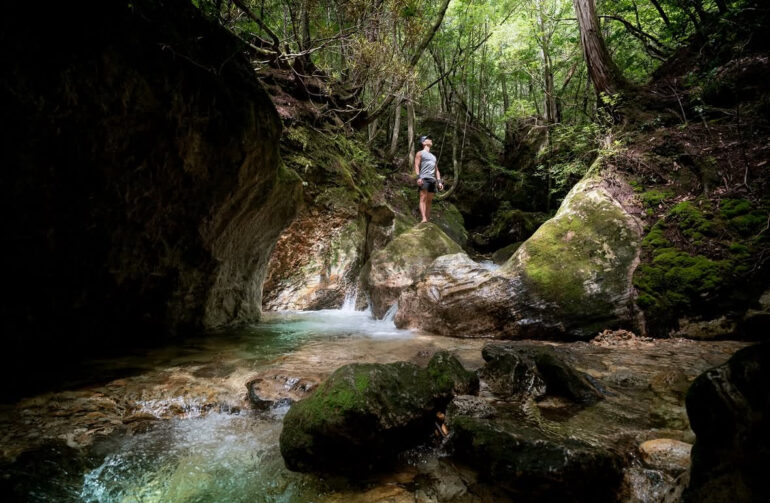
Working as a nature guide and spending my days in the mountains brought me into a different relationship with the world. Weather, terrain and other living things would not rearrange themselves around my intentions. I had to pay attention.
Eventually, I returned to the movement I had avoided for so long: running.
I took off my shoes and set aside the watch. Barefoot in the forest, I could no longer treat the ground as something to drive against without noticing it. There were young shoots, insects, roots and places where a careless step could hurt me.
Each step had consequences beyond the distance it covered.
I began to change how I ran. I paid attention to where my weight was going, how my feet met the ground, how much effort I was adding. My breathing and my awareness changed with the movement.
The forest did not tell me whether I was a good runner. It gave me something immediate to respond to.
For the first time in years, running held my attention without a result waiting at the end.
When the commentary falls silent
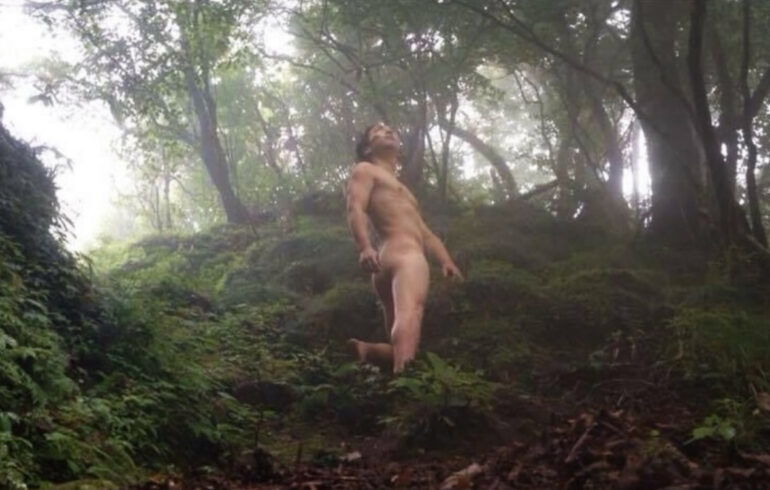
At times, that attention became so complete that the familiar boundary between myself and the surrounding world seemed to disappear.
I had spent so much of my life looking at myself from the outside: how I appeared, where I ranked, whether I was enough. In those moments, the commentary went quiet. There was breathing, contact, movement. I felt part of the place I was moving through.
This is what I mean when I speak of returning to myself.
My personality and my wishes were still there. What loosened was the demand to become someone else before I could feel at home in my own life.
I began to understand destiny in a quieter way. Living fully as the being I already was seemed more substantial than finding an exceptional role to perform.
When I returned to the city and began sharing what I had learned, I met people who associated running with the same heaviness I had known: struggling for breath, forcing the legs, waiting for the effort to be over.
I knew another experience was possible because I had lived it. Movement itself had become something I wanted to return to.
That did not make races or records meaningless. It changed what I asked them to mean.
What one tooth made visible
My encounter with Japanese single-tooth geta gave that exploration another form.
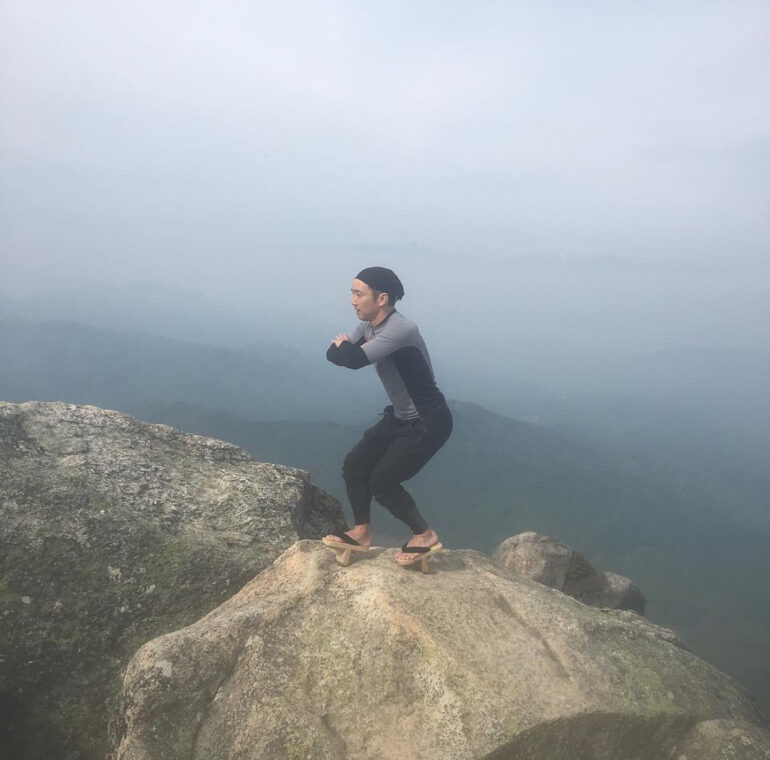
The structure looks simple: a wooden platform and one tooth beneath each foot. The foot rests on the platform; the tooth makes a narrow contact with the ground.
On that contact, habits become noticeable. Trying to hold everything still can tighten the calves, knees, shoulders or abdomen. A small change in weight can travel through the whole body. The response is immediate enough to feel.
I began to pay closer attention to the relationship between my feet, pelvis, rib cage and head. I could sense the difference between support that allowed the next movement and tension that obstructed it.
I call the resulting sense of connection an axis.
The muscles are still working. The body is still producing force. Yet the experience changes when the parts cooperate, when the next step follows the movement of the whole body instead of being dragged out by a separate effort of the leg.
Balance becomes an activity. Small movements continue. Attention continues.
What interested me was how much freedom could develop within such a small area of support.
Taking the question through 100 kilometres
I wanted to find out what remained of that feeling over a long distance.
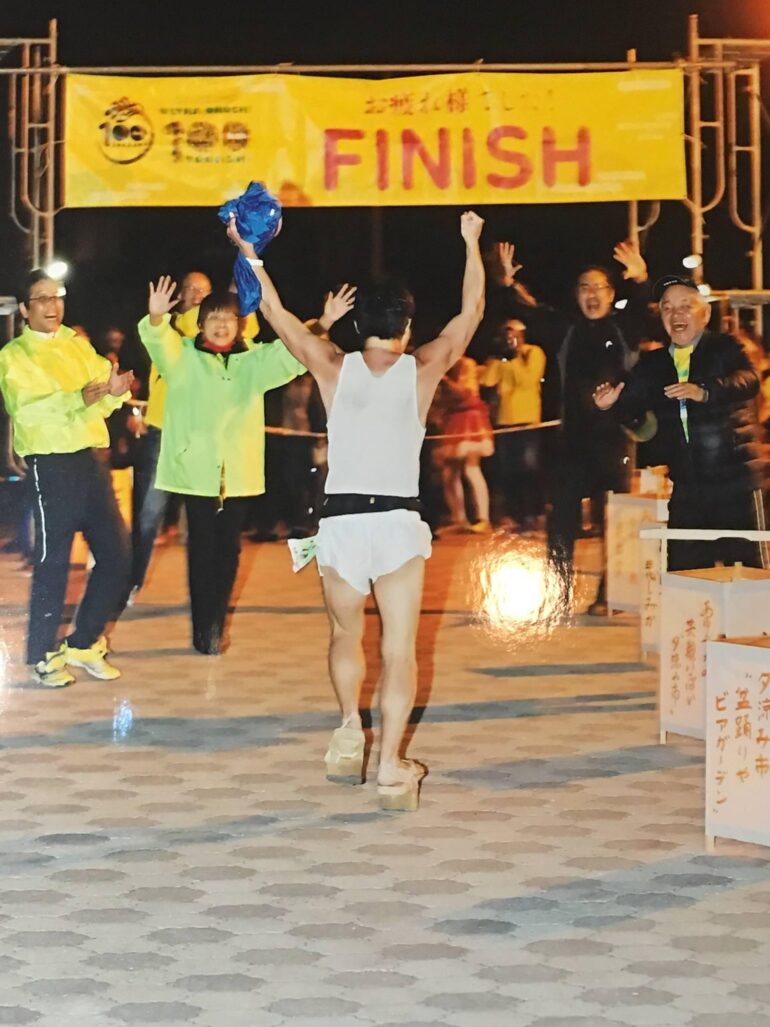
In April 2017, I completed the Okuizumo 100 km ultramarathon wearing conventional single-tooth geta. In 2018, I completed another 100 km race at Hakusan–Shirakawa-go, again in conventional geta. These experiences preceded the release of ippon blade.
A long race gave me hours to encounter the consequences of how I moved. Small tensions, repeated thousands of times, mattered. So did preparation, pace, food, fatigue and the changing condition of my body.
Finishing was a milestone. It also left me with more precise questions about the structure under my feet.
Where should the tooth sit? How should its height relate to the platform? How should the straps hold the foot? What happens to the movement as the sole wears?
The broad shape alone could not answer those questions. I needed to work with its details.
During a 100 km event in Nikko, I also had an experience that I describe as a vision: a crow tengu stirring the wind with a feather fan. The image of a single tooth connecting earth and sky stayed with me and became part of the inspiration for the design that followed.
The inspiration gave me a direction. Repeated practice and making gave it a physical form.
Where movement meets the hands of a craftsman
I met Mokuen, a woodcraft artisan who also knew long-distance barefoot running.
We could approach the same questions from different sides. I brought the movement I wanted to explore and the experience of teaching it. Mokuen brought an understanding of wood, proportion, strength and the precision of making.
The position of the tooth, the height, the shape of the platform and the way the straps held the foot became decisions to revisit through prototypes and use.
A drawing had to become wood. The wood then had to meet a moving body.
That exchange became ippon blade.
The golden ratio informed the design of 369 MIROKU. The Japanese Yamato proportion informed 1000 ZEN. These proportions belong to our design language; the work of refining a pair happens through its actual dimensions, materials, construction and use.
In 2022, I completed the Tobishima Kaido 100 km ultramarathon wearing ippon blade. The journey from conventional geta to our own design had come back to the road.
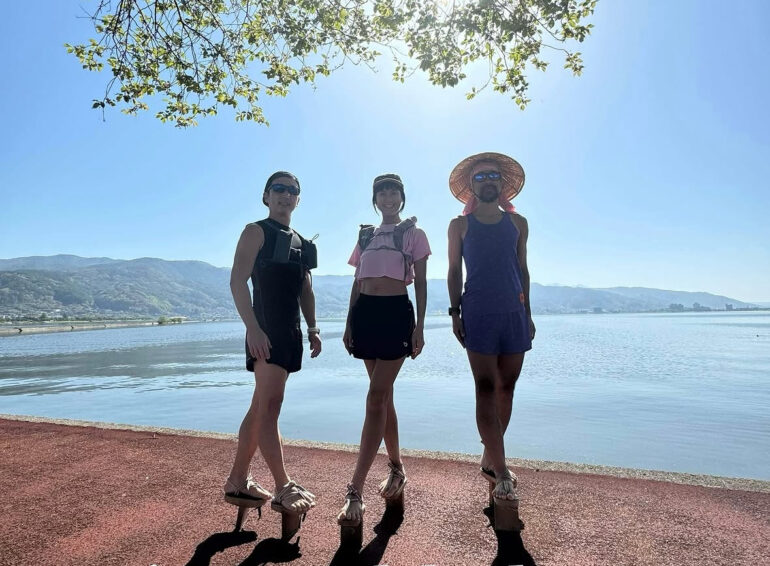
Ayari has also completed a 50 km race in ippon blade, and Mokuen has completed 100 km in it. Their experience is part of the work, alongside what we continue to learn from the people we teach.
Today, I work with Ayari and Mokuen across practice, teaching, making and the running of the project. Different parts of that work call for different combinations of us. The movement and the craft keep informing one another.
The movement belongs to the person
ippon blade grew out of running, but its possibilities reach into walking, yoga, martial arts, dance and everyday practice.
A runner may explore the timing of a step. Someone else may spend a few minutes noticing where they are gripping unnecessarily. Another person may discover a movement they had never thought to try.
The purpose is not to make all of them move alike.
Gravity acts on every one of us. Whenever we are in contact with the ground, we exchange forces with it. Our proportions, histories, abilities and intentions differ. Those differences are part of the practice.
I respect the runner who wants to race, the person who wants to walk quietly, and the person who simply enjoys playing with movement. Shoes and bare feet also have their place in that exploration.
The question I keep returning to is how closely I am attending to what is happening now.
A narrow support does not make that attention automatic. It gives it somewhere concrete to begin. From there, each person has to learn, adjust and decide for themselves.
Start with the fitting guidance and supported practice. The long distances in this story came after years of experience; the first useful discovery may happen while standing still.
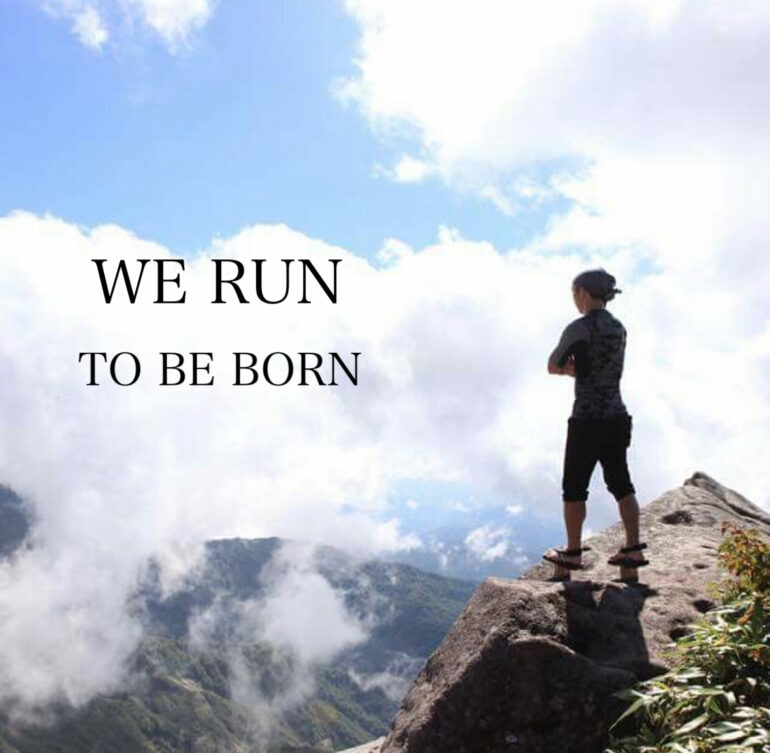
We run to be born
I still enter races. I still care about completing a distance. What has changed is that the finish line no longer has to decide who I am.
There is another reward within the running itself: feeling a step meet the ground, responding to a change in terrain, finding that my whole body is involved. The movement is already worth being there for.
“Being born” is the phrase I use for coming into that direct experience again.
It happens in this body, with its history and its limits. It does not erase what came before. It lets the next step be more than a repetition of an old demand.
That is what I want to share through ippon blade.
To my brothers and sisters around the world: there is room here for your own pace, your own curiosity, your own way of moving.
Return to your axis.
Then see where the next step takes you.
Ten Kodaira (TEN)
Founder & Inventor of ippon blade · TENARI
Continue reading
Return to Your Axis explores the relationship between support, movement and the freedom to respond. For product background and practical questions, see Q&A: Foundations & Philosophy.